Animal groups
Lizards and salamanders: scales, skin and space
A small animal with a long body and tail can be hard to place at a glance. Lizards and salamanders may share a similar outline, and their colors can overlap; some lizards, such as the UK slow-worm, have no visible limbs. Looking at skin covering and other clear features can help, but the safest and most useful comparison happens from a distance.
Quick answer
Lizards are reptiles with scales; salamanders are amphibians with skin that is often smooth or moist, though texture varies. Use this as a broad clue, never as a reason to touch or catch an animal.
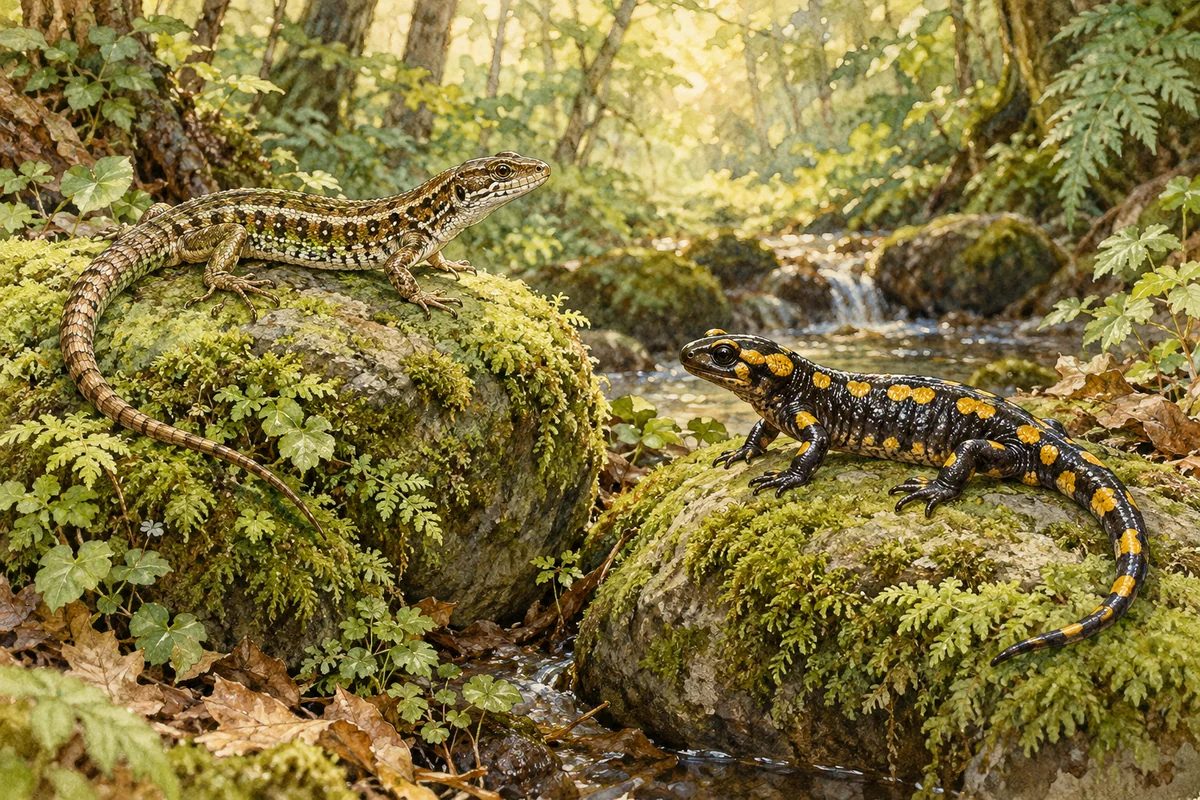
A broad difference in skin
Lizards are reptiles. Amphibian and Reptile Conservation explains that lizards have scaly skin, while newts have smooth skin that may appear velvety on land, or can be bumpy and warty. Newts are salamanders, so this comparison gives a practical clue for distinguishing a lizard-like reptile from a salamander-like amphibian.
The National Park Service describes amphibian skin as smooth and moist and contrasts it with reptile scales. This is a useful broad-group teaching point, not a perfect species test. A photo can blur scales, a wet surface can shine, and salamander skin is not always identical across species.
Sources: Amphibian and Reptile Conservation: Lizards FAQs · NPS Everglades: Amphibians of the Everglades
Notice the outline and the setting
Without moving closer, note the body shape, tail, any visible limbs and where the animal is. Is it beside a pond, under leaf litter or on a sunny stone? Habitat can provide context, but it does not settle the answer. Some salamanders live away from open water for much of their adult life, and some reptiles are found near damp places.
ARC notes that lizards and newts can be similar in size and color. It describes lizards as more likely to scurry away quickly when disturbed and newts as moving more slowly, while qualifying that as a general tendency. You do not need to disturb the animal to test this. If it moves naturally while you are watching, record what happened.
Do not test the clues by touching
Skin texture and toe counts should come from a clear view, not from catching or handling the animal. Amphibians can be vulnerable to damage and drying, and some have skin secretions. The point of the comparison is to observe a living animal without interfering with it.
If the photo does not show whether the skin has scales, record “small lizard-like animal” or “possible salamander/newt.” A broad, honest description is more useful than a confident name based on a hidden feature. For a species-level guess, use a regional guide and more than one visible clue.
Sources: Amphibian and Reptile Conservation: Lizards FAQs · NPS Everglades: Amphibians of the Everglades · Amphibian and Reptile Conservation: I’ve found an animal in my house
A legless lizard is still a lizard
The UK Amphibian and Reptile Conservation Trust lists the slow-worm as a legless lizard and notes that it is often mistaken for a snake. This is a useful exception to the familiar picture of a four-legged lizard. The absence of visible legs does not make a long-bodied animal a salamander or snake by itself.
If you see a long, smooth-looking animal in a UK garden, record that appearance and location without uncovering or handling it. ARC’s slow-worm page offers further regional comparison guidance; elsewhere, use a local reptile and amphibian reference. From a distant or partial image, keep the label broad when the useful features are not clear.
Keep the animal’s route open
Do not lift rocks, logs or plant cover just to look for a better view. These places can be important shelter. If the animal is already visible, stay still and let it leave when it chooses. If it disappears, the observation can end there; the animal’s need for cover matters more than a complete photograph.
Lizards and salamanders can resemble one another in size and shape, but a broad look at scales versus amphibian skin can guide a cautious first comparison. Use the clue to ask a better question, not to guarantee an identification or justify handling wildlife.
Sources: Amphibian and Reptile Conservation: Lizards FAQs · NPS Everglades: Amphibians of the Everglades
Record, then compare
- Note where the animal is and what is visible from your current position.
- Look for scales only if the image is clear; otherwise mark skin detail unknown.
- Add body shape or naturally observed movement as separate clues.
- Compare with a guide for the region and stop at a broad label if evidence is limited.
Takeaways
- Scales suggest a reptile such as a lizard; salamanders are amphibians with variable skin texture.
- Movement and habitat can add context but do not prove identity.
- Never catch or touch an animal to inspect a feature; leave shelter and escape routes undisturbed.
Sources and further reading
Sources checked 17 Oct 2026.
Have a photo of your own?
Choose a photo on Home and select Analyze — your photo is sent only when you ask for the analysis.
Discover an animal