Animal groups
Frogs and toads: similar neighbors, not a simple split
People often picture frogs as smooth-skinned jumpers and toads as bumpy walkers. That picture can help with familiar local animals, but it can also make the groups seem more separate than they are. A careful comparison notices tendencies and then leaves room for different species, names and life histories.
Quick answer
Smooth skin, warty skin, leg proportions and movement can be useful clues in some regions, but they are not universal rules. “Toad” is also a common name used across more than one frog family.
Start with what is visible
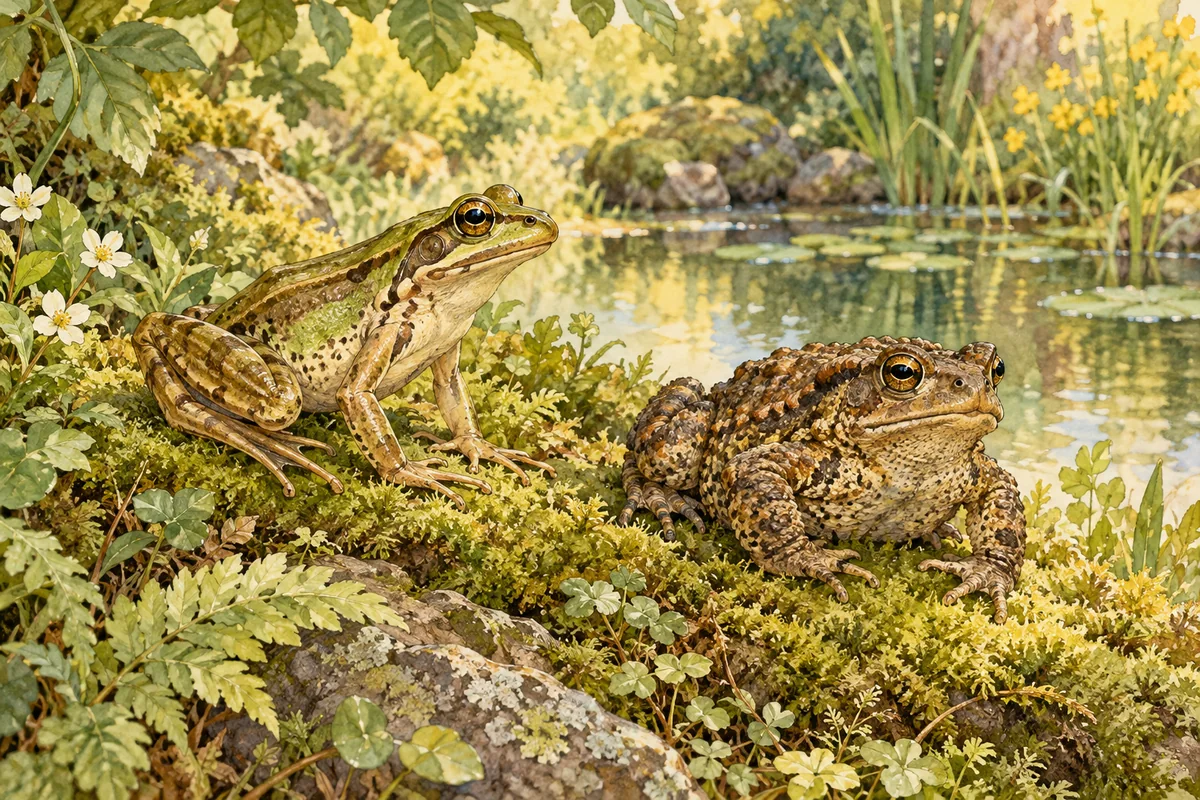
In its UK guide, Amphibian and Reptile Conservation says frogs usually have smoother skin, while toad skin tends to be more warty. Common toads often have shorter legs and may walk or hop; common frogs have longer, muscular legs. These are useful features to observe when the animal is clearly visible, not a universal field test for every amphibian on Earth.
Color is particularly easy to overread. ARC notes that common frogs vary in color and pattern. A brown animal is not automatically a toad, and an unusual shade does not automatically mean a rare species. Record the texture, shape and movement separately so one impression does not control the whole guess.
Sources: Amphibian and Reptile Conservation: Frogs & toads FAQs
Everyday names and scientific groups
Toads belong within the frog order Anura. The everyday name toad applies to members of several families rather than a separate scientific group. The American Museum of Natural History’s Amphibian Species of the World database lists toads as a common name for Bufonidae, while another family, Megophryidae, includes common names such as Asian toads and litter frogs.
For a beginner, this does not mean the words frog and toad are useless. They are familiar names for animals with recognizable patterns and histories. It means the names do not create a universal two-box key. When the distinction is unclear, “frog or toad-like amphibian” is more honest than pretending one visual trait defines every species.
Sources: AMNH: Amphibian Species of the World—Anura · AMNH: Amphibian Species of the World—Bufonidae · AMNH: Amphibian Species of the World—Megophryidae
Try a clue-by-clue comparison
Suppose you see a small amphibian beside a garden pond. Note whether the skin appears smooth or textured, whether the legs look long or short relative to the body, and whether it jumps, hops or walks. Then consider the region and habitat. Write a description first, such as “brown amphibian with textured skin and short-looking legs, walking through damp leaves.” A local guide can help compare it with species known there.
Do not force a species-level answer from one frame. The animal may be partly covered, damp skin may reflect light, or the image may not show the legs. A sequence of observations can add movement and scale, but no picture guarantees a correct identification.
Sources: Amphibian and Reptile Conservation: Frogs & toads FAQs · AMNH: Amphibian Species of the World—Anura
When the photograph hides the clue
A view from above, a reflection on damp skin or a body partly covered by leaves can make texture and leg proportions hard to judge. If a photo does not show those features clearly, do not turn “not visible” into “smooth,” “warty,” “long-legged” or “short-legged.” ARC’s frog/toad comparisons describe tendencies for familiar UK species, not a test for every amphibian.
If all you can see is a small amphibian shape beside a pond, say that. If the surface and legs are clear, describe those observations separately and compare them with a regional source. Common names vary across groups, so an uncertain photo may support only “frog-like amphibian,” not a firm frog-versus-toad or species claim.
Sources: Amphibian and Reptile Conservation: Frogs & toads FAQs · AMNH: Amphibian Species of the World—Anura · AMNH: Amphibian Species of the World—Bufonidae · AMNH: Amphibian Species of the World—Megophryidae
Watch without handling
Amphibians have sensitive skin. A visual comparison should never become a reason to pick one up, test its texture or move it to water. Watch from a respectful distance and let it continue its route. If an animal appears trapped or in danger, follow local wildlife guidance rather than improvising based on a photo.
Local species lists matter. ARC’s examples describe UK frogs and toads, while the AMNH database spans global taxonomy. A familiar pattern from one place may not fit another. Keep the broad label when the evidence is limited, and let curiosity lead to a regional reference instead of an overconfident answer.
Sources: Amphibian and Reptile Conservation: Frogs & toads FAQs · AMNH: Amphibian Species of the World—Anura · Amphibian and Reptile Conservation: I’ve found an animal in my house
A clue table, not a two-box test
| Observation | How to use it |
|---|---|
| Smoother-looking skin | May fit some frogs; note the lighting and image quality. |
| Warty-looking skin | May fit some toads; not a universal definition. |
| Longer-looking hind legs | A clue in the UK common-frog comparison. |
| Walks rather than jumps | Record it if seen; movement can vary and may not be visible. |
- Observation
- Smoother-looking skin
- How to use it
- May fit some frogs; note the lighting and image quality.
- Observation
- Warty-looking skin
- How to use it
- May fit some toads; not a universal definition.
- Observation
- Longer-looking hind legs
- How to use it
- A clue in the UK common-frog comparison.
- Observation
- Walks rather than jumps
- How to use it
- Record it if seen; movement can vary and may not be visible.
Takeaways
- Skin texture and leg proportions are clues, not universal rules.
- Common names such as “toad” do not map neatly to one group worldwide.
- Describe region, habitat and visible features; do not handle amphibians to check them.
Sources and further reading
Sources checked 17 Oct 2026.
Have a photo of your own?
Choose a photo on Home and select Analyze — your photo is sent only when you ask for the analysis.
Discover an animal