Observe with care
Start a nature journal: notice, sketch, wonder
You do not need special art supplies or expert knowledge to start a nature journal. A scrap of paper, pencil and a few quiet minutes are enough. The practice is less about making a perfect drawing and more about slowing down to notice details you might otherwise miss.
Quick answer
A nature journal can be as simple as a dated note and a quick sketch of what you saw, heard or wondered about. It records your observation; it does not automatically verify an identification.
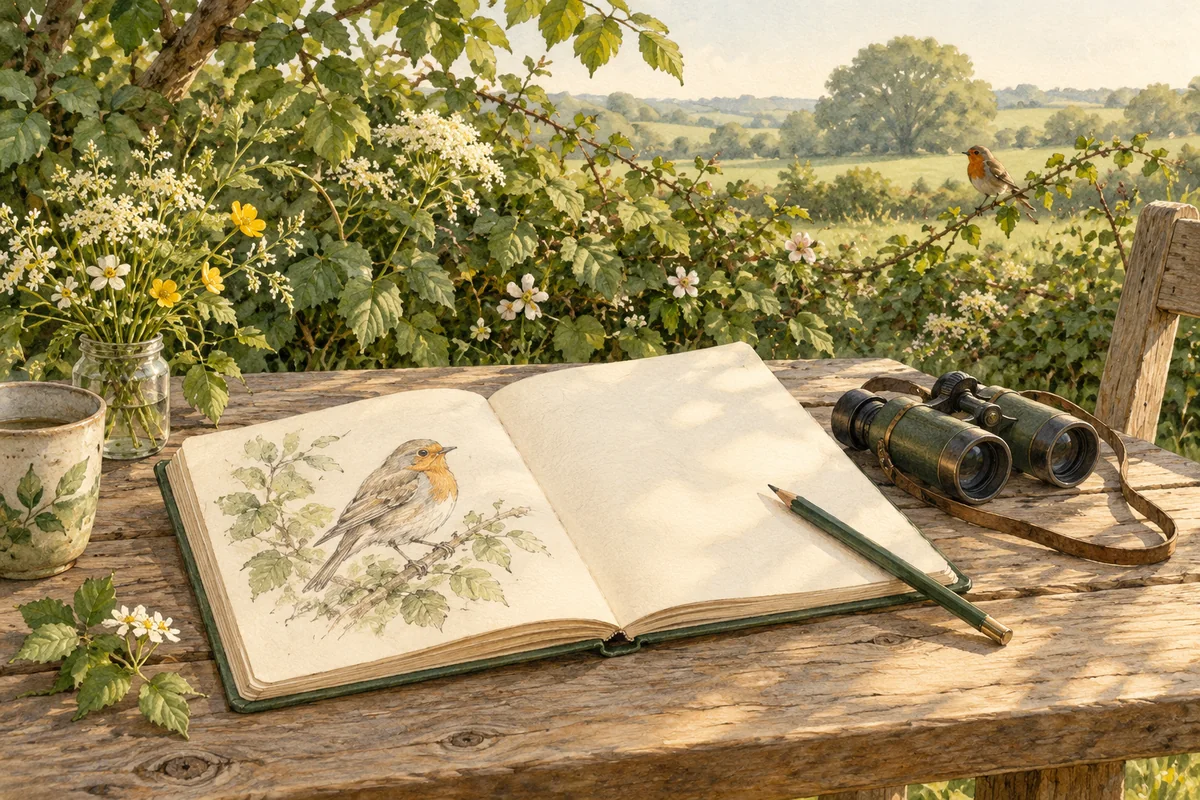
Begin with a date and a place
Write when and generally where you are observing, such as “Sunday morning, back garden” or “late afternoon, park path.” You can include the weather or light if it helps explain what you saw. Keep private location details private; a personal journal does not need to publish a precise address.
The National Park Service’s junior nature-sketchbook activity invites learners to find a safe, quiet place, look closely and write or draw what they observe. This is a useful starting point for any age: choose one small scene rather than trying to record the whole outdoors.
Sources: NPS Rocky Mountain: Junior Ranger Journal/Nature Sketchbook · NPS Kenai Fjords: Nature Journaling—Tips and Tricks
Separate observations from questions
Write an “I notice” sentence about what is visible or audible: “The leaf has three dark spots,” “I hear two calls from the hedge,” or “The insect pauses at each flower.” Then add an “I wonder” question: “Does this bird return at the same time each day?” or “What made the spots?”
The NPS journaling tips encourage students to attend to details and ask questions. Keep observations separate from explanations. “The stem is bent” is something you can see; “the wind bent it” is a possible explanation that may need more evidence.
Sources: NPS Kenai Fjords: Nature Journaling—Tips and Tricks
Sketch quickly, even when the subject moves
A journal sketch can be a few shapes and arrows. Draw the animal’s outline, the direction it moved or the pattern of a leaf. If it is moving, make several tiny sketches rather than trying to produce one polished picture. The NPS Kenai Fjords nature-journaling materials describe quick sketches as a way to learn about an animal’s movement and habits.
Label what matters: “long tail,” “pale edge,” or “wing mark unclear.” A drawing does not have to prove a species name. If a feature is too small to see, mark it as unknown rather than filling it in from what a guide picture shows.
Sources: NPS Kenai Fjords: Nature Journaling · Cornell Lab: Bird ID Skills—Field Marks
A small example from the garden
A journal entry can preserve one moment in enough detail to compare later. For example: “10:05 a.m., cloudy, back garden. A blackbird searched under the hedge for about a minute, then flew to the fence. I saw it turn leaves with its bill. I wonder whether it returns after rain.” Add a quick line drawing of the hedge and an arrow for the bird’s path.
The dated note keeps the observation, place and question together without claiming why the bird searched there. On another day, you can add a separate entry and compare what changed. If you do not see the bird again, the first entry remains an account of one visit.
Sources: NPS Mammoth Cave: Backyard Explorer · NPS Kenai Fjords: Nature Journaling
Compare entries over time
Look back at entries after a week or season. What changed in the plants, sounds or animal activity? NPS journaling activities use observation over time and comparison as learning exercises. A repeat visit can help you notice patterns, but a few entries do not prove a broad scientific claim. Write down how often and when you observed so you remember the limits of your notes.
If a species name matters, compare several visible features with a regional guide or ask a qualified local naturalist. Keep the original observation intact even if your later identification changes. A journal can hold both: what you first noticed and what you learned afterward.
Sources: NPS Kenai Fjords: Nature Journaling · RSPB: Seven top tips on how to ID birds
Keep the practice gentle and personal
Choose a place where you can observe without approaching nests, handling animals, moving shelter or feeding wildlife. If an animal reacts to you, step back. You can still write about the plants, weather, sounds and empty spaces around you. Quiet attention is a complete nature activity even when no animal appears.
This journal is for your own learning. Animal Says Hi has no dedicated date or location fields; its optional context box accepts free text. The site does not publish your journal or turn it into a public wildlife record. It accepts one image, not sound or a multi-photo observation. If you want to share a record with a monitoring project, use that project’s official instructions and share only the information it asks for.
Sources: U.S. National Park Service: 7 Ways to Safely Watch Wildlife · NPS Mammoth Cave: Backyard Explorer · NPS Kenai Fjords: Nature Journaling · Animal Says Hi: Help
A simple journal entry
| Prompt | Example |
|---|---|
| When and where? | Morning, from a quiet garden seat |
| I notice… | A bird searches under the hedge |
| I wonder… | Does it return after rain? |
| Sketch | Simple outline and movement arrow |
- Prompt
- When and where?
- Example
- Morning, from a quiet garden seat
- Prompt
- I notice…
- Example
- A bird searches under the hedge
- Prompt
- I wonder…
- Example
- Does it return after rain?
- Prompt
- Sketch
- Example
- Simple outline and movement arrow
Takeaways
- Date a note, describe what you noticed and add one question.
- Use quick sketches and label uncertain details instead of inventing them.
- A personal journal is an observation, not a verified identification or public wildlife record.
Sources and further reading
Sources checked 17 Oct 2026.
- NPS Rocky Mountain: Junior Ranger Journal/Nature Sketchbook
- NPS Kenai Fjords: Nature Journaling—Tips and Tricks
- NPS Kenai Fjords: Nature Journaling
- NPS Mammoth Cave: Backyard Explorer
- U.S. National Park Service: 7 Ways to Safely Watch Wildlife
- Cornell Lab: Bird ID Skills—Field Marks
- RSPB: Seven top tips on how to ID birds
- Animal Says Hi: Help
Have a photo of your own?
Choose a photo on Home and select Analyze — your photo is sent only when you ask for the analysis.
Discover an animal