Animal groups
Bees, wasps and hoverflies: similar stripes, different clues
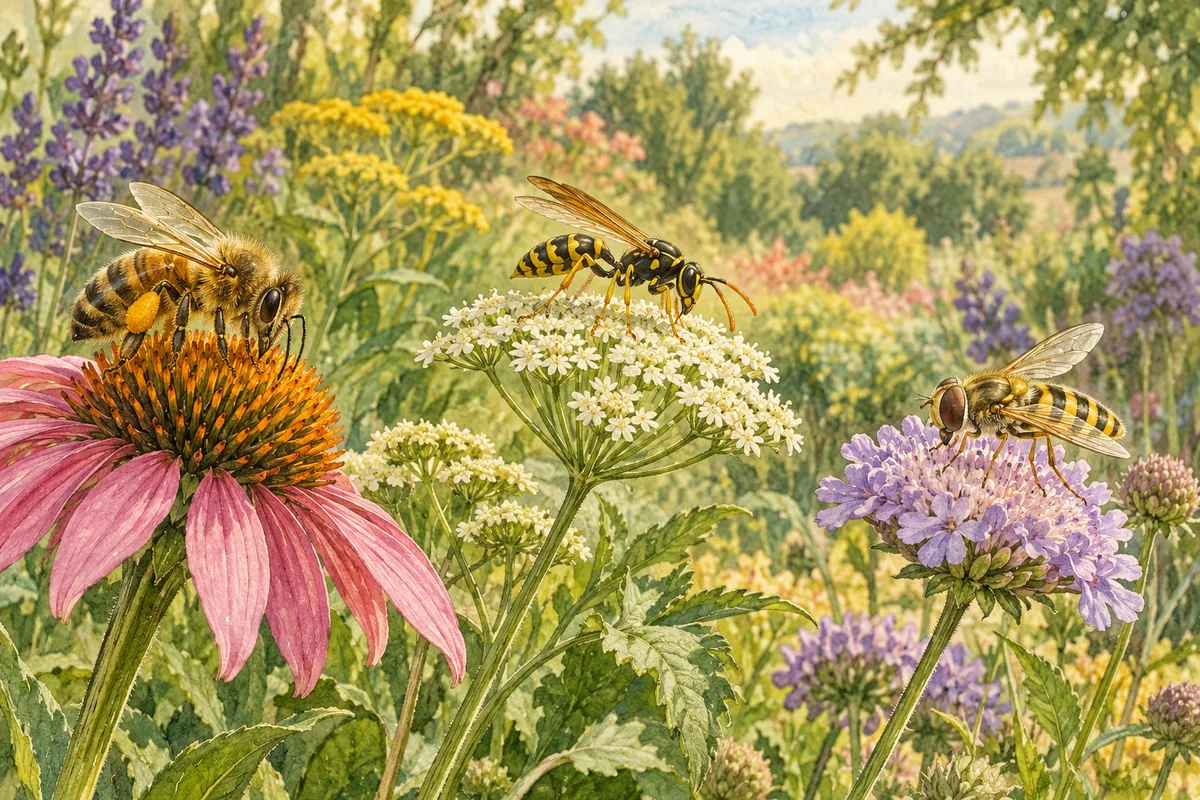
A black-and-yellow insect hovering over a flower might be a bee, a wasp or a hoverfly. Their patterns can overlap because some hoverflies imitate bees or wasps. Rather than trusting color alone, look for a few details that can actually be seen—and leave the safety question open.
Quick answer
Some hoverflies mimic bees and wasps. One versus two pairs of wings and antenna features can help when clearly visible, but a photo may hide them; appearance alone cannot guarantee whether an insect can sting or is safe to approach.
Why stripes can fool us
The Royal Horticultural Society describes hoverflies as true flies that often mimic the markings of wasps, honeybees or bumblebees. The Natural History Museum gives the example of a hoverfly that closely resembles a white-tailed bumblebee. Similar color patterns are a reason to slow down, not a reason to assume two insects are the same.
A rounded, fuzzy body may suggest a bumblebee, while a sleeker body can suggest a wasp, but there are lookalikes and unusual species. A still image removes clues such as flight style and sound, and color can shift with lighting. Describe what you can see before naming it.
Sources: RHS: Hoverflies · Natural History Museum: Rainbow nature—life in dazzling yellow
Wings and antennae can be useful
Hoverflies are true flies and have one pair of wings; winged bees and wasps have two pairs. When the wings are open and sharp enough to count, this can be a useful broad clue. Bees often have longer antennae than hoverflies, and a bumblebee’s banding, tail color, face, hair and legs can help with more detailed identification.
The Bumblebee Conservation Trust emphasizes looking at several features and trying different views. It notes that a typical bee-on-flower photo may hide the tail tip and hind legs, and that antenna segments or face shape can be difficult to see. If the feature is hidden, do not infer it from the insect’s color.
Sources: RHS: Hoverflies · Natural History Museum: Rainbow nature—life in dazzling yellow · Bumblebee Conservation Trust: Identifying bumblebees · Bumblebee Conservation Trust: Using photographs for ID
A photo is only one view
Try a simple evidence table: wings visible? antennae visible? body hair visible? tail bands visible? Add “yes,” “no,” or “not shown.” The final option matters. A cropped photo with wings tucked against the body may not let you count wing pairs. A close-up of the top of an insect may hide its face and legs.
For example, if an insect appears to show one pair of wings, a second pair may be folded, overlapped or hidden by the angle. Record the count as unresolved unless both pairs of wings can be distinguished clearly; do not turn a partly seen wing count into a hoverfly label. If the wings are blurred, write “striped flying insect; uncertain.” You have still learned something by distinguishing observed features from guesses.
Sources: Bumblebee Conservation Trust: Using photographs for ID · RHS: Hoverflies
Do not infer sting risk
A photo-based identification is not a safety guarantee. This guide does not ask you to approach, touch or catch an insect to inspect its wings or antennae, and a color pattern alone cannot establish what will happen if a person gets close. Keep a respectful distance, especially around a nest or a cluster of insects.
If you are concerned about an insect indoors or near a nest, seek locally appropriate expert advice rather than relying on a broad image label. The goal here is learning to observe, not deciding that an insect is harmless. Leave it room to move and avoid swatting or disturbing it.
Sources: RHS: Hoverflies · Bumblebee Conservation Trust: Using photographs for ID
Practice a careful observation
Watch a visiting insect from where you are. Note whether it is alone, whether wings are clearly visible, and whether it repeatedly visits flowers. Do not move flowers, block its path or follow it to a nest. If it leaves, let the observation end.
A useful note might read: “Small striped insect hovering at a flower; wings too blurred to count; antennae not visible; possible hoverfly or bee.” If you later find a sharper view, compare multiple features using a specialist guide. When you only have a photo, your best answer may remain at the group level.
Sources: RHS: Hoverflies · Bumblebee Conservation Trust: Identifying bumblebees · Bumblebee Conservation Trust: Using photographs for ID
What does the photo actually show?
| Feature | Record |
|---|---|
| Wing pairs | Visible / hidden / unclear |
| Antennae | Long, short, or not resolved |
| Body hair and shape | Describe without deciding safety |
| Flower visit or flight | Observed behavior, if seen |
- Feature
- Wing pairs
- Record
- Visible / hidden / unclear
- Feature
- Antennae
- Record
- Long, short, or not resolved
- Feature
- Body hair and shape
- Record
- Describe without deciding safety
- Feature
- Flower visit or flight
- Record
- Observed behavior, if seen
Takeaways
- Hoverflies can mimic bees and wasps, so stripes alone are not enough.
- Count wings or inspect antennae only when the image clearly shows them.
- Never treat a photo identification as a sting-risk or safety guarantee.
Sources and further reading
Sources checked 17 Oct 2026.
Have a photo of your own?
Choose a photo on Home and select Analyze — your photo is sent only when you ask for the analysis.
Discover an animal